
Sources: Reuters, AP News, NTSB Reports, FAA, and ALPA
1. The Tragedy Beyond the Runway
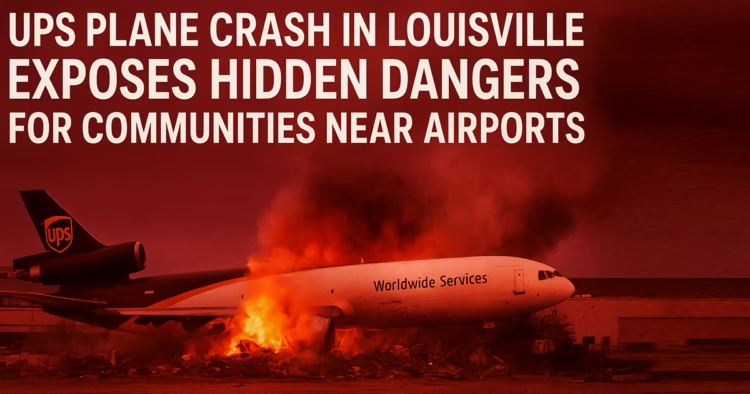
At 3:04 a.m. in Louisville, the sky glowed orange over the industrial blocks bordering Muhammad Ali International Airport. The UPS plane crash in Louisville occurred when a UPS MD-11 cargo plane, inbound from Dallas–Fort Worth, was on its final approach. Within moments, the aircraft banked sharply, lost altitude, and slammed into a row of warehouses just beyond the airport perimeter.
The impact triggered an explosion that ripped through a cluster of night-shift logistics centers — the very facilities feeding the supply chains the aircraft was meant to serve.
By dawn, six people were confirmed dead: two UPS pilots and four ground workers. Another dozen were injured. Investigators from the National Transportation Safety Board (NTSB) arrived within hours, yet deeper questions lingered long after the flames were out.
This wasn’t just an aviation accident — it was a community impact event.
2. The Hidden Risk Zone Around Airports
For decades, aviation safety discussions have focused on cockpit protocols, pilot fatigue, and mechanical reliability. Rarely do they extend beyond the aircraft itself. But the UPS plane crash in Louisville — like others before it — exposes a blind spot in aviation policy: the dangers faced by people living or working near major airports.
Cargo hubs such as UPS’s Worldport in Louisville are economic lifelines. Operating 24/7, Worldport handles more than 400 flights daily and employs over 25,000 people. Yet this success has fueled dense development within what experts call “impact corridors” — zones extending roughly two miles from active runways.
According to FAA zoning data, more than half the structures in these corridors are warehouses, distribution centers, or even residential neighborhoods — a figure that has tripled since 2000.
When disaster strikes, proximity turns deadly.
3. The Ground Toll: A Historical Pattern
Aviation disasters are often measured by onboard fatalities. Yet the ground toll from cargo-related crashes is quietly — and steadily — rising.
Between 2000 and 2024, the NTSB recorded 37 cargo plane accidents in the U.S.:
- 42% caused ground fatalities or major off-airport damage.
- Nearly all occurred within two miles of a runway.
- Most took place at night, during peak cargo operations.
Louisville’s tragedy follows a troubling pattern:
- Birmingham, Alabama (2013): A UPS Airbus A300 crashed on approach, killing two crew members and damaging nearby homes.
- Taipei, Taiwan (2015): A TransAsia ATR-72 clipped a bridge, hit a taxi, and plunged into a river.
- Tokyo, Japan (2009): A FedEx DC-10 crash narrowly avoided igniting fuel tanks that could have devastated nearby neighborhoods.
Each incident reignites the same question:
How close is too close when building near airports?
4. What Went Wrong in Louisville
As of November 2025, the Louisville investigation remains ongoing, but early findings suggest several contributing factors:
- Mechanical anomaly: Preliminary data points to a possible hydraulic control failure affecting pitch stability during descent.
- Pilot workload: The MD-11 has a history of “hard landings” and “pitch oscillations,” making it one of the more demanding aircraft to land safely.
- Night operations: The flight occurred during UPS’s busiest overnight window, when fatigue and limited visibility heighten risk.
Both flight recorders were recovered intact. Weather was stable. The final descent path shows the aircraft came down roughly 300 yards short of the runway — directly over an active industrial park filled with night-shift workers.
“Every second counts in a low-altitude loss-of-control event,” said Aviation Safety Analyst Paul Drexler, speaking to Reuters. “But when you add dense ground occupancy right at the approach path, you expand the casualty radius dramatically.”
5. The Zoning Dilemma: Growth vs. Safety
Louisville’s planners now face a dilemma shared by airport cities worldwide.
The airport–industrial nexus — logistics hubs, freight warehouses, and e-commerce distribution centers — drives local economies but places thousands of workers inside potential impact zones.
A 2023 FAA land-use study recommended a 1,500-foot buffer between runway thresholds and industrial developments. In practice, those guidelines are rarely enforced.
“Economic development often trumps safety zoning,” admits urban planner Dana Kerr, who helped draft Louisville’s metro redevelopment plan. “Airports attract jobs, and land near them is cheap. But when we build right up to the fence line, we forget the invisible risk overhead.”
This issue extends beyond the U.S. In Hong Kong, high-rise apartments stand within half a mile of approach paths. In Leipzig, Germany, DHL’s night hub borders dense housing — a situation local officials call “an acceptable urban trade-off.”
6. The Human Element: Workers on the Front Line
For those on the ground, the UPS plane crash in Louisville wasn’t a freak event — it was a predictable occupational hazard hiding in plain sight.
All four ground fatalities were warehouse employees working the night shift.
One survivor told AP News:
“We hear planes every few minutes — it’s background noise. You never think one could fall right on top of you.”
This disconnect between economic dependence on aviation and awareness of spatial risk is stark.
At UPS’s Worldport, aircraft take off or land every 90 seconds during peak hours, directly above thousands of workers. Yet no federal rule requires evacuation plans for warehouse staff in the event of a crash. Local emergency protocols primarily address on-runway incidents — not off-site impacts.
7. Why the MD-11 Keeps Coming Up
The McDonnell Douglas MD-11, though retired from passenger fleets, remains a cargo workhorse. Its safety record, however, is mixed — with more than a dozen hull losses linked to landing instability and control issues.
The Air Line Pilots Association (ALPA) has repeatedly called for improved simulator training and faster fleet modernization. Following the UPS plane crash in Louisville, ALPA renewed its push to retire older MD-11s from night operations.
“The MD-11 isn’t inherently unsafe,” the association stated. “But its design leaves very little margin for error during final approach.”
8. Community Preparedness: Are We Ready for the Next One?
The Louisville Fire Department’s rapid response prevented an even greater catastrophe. Yet the incident revealed critical preparedness gaps:
- No pre-planned drills simulated off-airport impacts.
- Communication delays between airport control and city dispatch slowed early response.
- Several nearby facilities lacked fire suppression systems capable of handling aviation-fuel explosions.
In the aftermath, officials proposed joint emergency protocols involving airport management, logistics companies, and fire services — a crucial step toward integrated disaster planning.
Still, as one safety expert observed:
“Preparedness remains reactive — until policy becomes proactive.”
9. The Economic Paradox
Ironically, the industries that rely most on cargo aviation are also the ones most exposed to its dangers.
Companies like UPS, Amazon, and FedEx have fueled rapid development in airport-adjacent zones across the country. The demand for just-in-time delivery has effectively urbanized runways.
Louisville illustrates the trade-off clearly:
- The airport handles more than 300,000 tons of freight per month.
- Logistics contributes $6.5 billion annually to the local economy.
- Nearly 8,000 night-shift workers operate within a two-mile radius of the runway.
It’s a symbiotic yet fragile relationship — one that turns cities into living extensions of the global supply chain.
10. Lessons from the Crash: A New Conversation
Every aviation accident leaves lessons, but Louisville’s may prove particularly urgent:
Safety cannot stop at the airport fence.
Urban planners must treat flight paths as living risk zones, not abstract lines on a map.
Cargo operators should audit the safety of surrounding communities.
And regulators need to update zoning policies for an era where airports and cities are inseparable.
The NTSB’s final report, expected in mid-2026, will likely identify both technical and procedural failures. But unless those findings translate into policy reform, similar tragedies may occur again.
11. The Debate That Must Be Had
And so, one question remains:
Would you live or work near a major airport hub if you truly understood the risks?
For decades, we’ve accepted airports as safe neighbors — vital, efficient, and largely invisible. Yet the UPS plane crash in Louisville reminds us that when something goes wrong in aviation, the consequences don’t respect boundaries.
Every takeoff and landing carries not just passengers or parcels — but an invisible perimeter of risk stretching far beyond the runway.
Perhaps it’s time we finally talked about it.
12. Sources
- Reuters (Nov 2025): “UPS cargo plane crashes near Louisville airport, killing six”
- Associated Press (Nov 2025): “Crash near UPS hub highlights airport-adjacent safety concerns”
- National Transportation Safety Board (2024–2025): Annual Accident Data Review
- Federal Aviation Administration (FAA): Land Use and Airport Safety Study (2023)
- Air Line Pilots Association (ALPA): Safety Bulletin on MD-11 Operations (2025)

No Comments
Leave Comment